
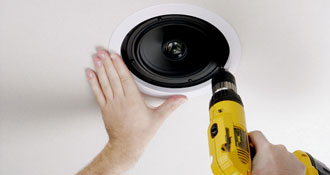
One of the most important parts of the installation process is making sure you have all the necessary tools before you start. We also recommend writing down a wire and speaker placement plan before beginning to keep the installation efficient and organized.
Tools needed:
1
Locate Joists and Mark the Cutout
Use the stud finder to locate a center point between two joists and mark it with the construction pencil. Then use the included template to trace the cutout pattern on the ceiling where the speaker will be installed.
2
Cut the Hole
Using a saber saw, keyhole saw, or sharp utility knife, carefully cut the ceiling following the traced pattern. Before cutting, check for any existing wiring in the area to avoid cutting it. Do not stand directly beneath where you are cutting — debris will fall.
3
Run and Connect Speaker Wire
Speaker wire will need to be run through the ceiling from the location of your AV receiver. Depending on speaker placement, wire may need to pass through support beams using a cable snake. If you are not comfortable with this step, consult a professional installer. Once the wire is accessible at the cutout, trim back the jacket about ¾" to expose the conductors. Connect positive to the red terminal and negative to the black terminal, observing correct polarity.
4
Mount the Speaker
Place the speaker into the hole and tighten the mounting screws with a Phillips head screwdriver. The screws rotate the mounting wings (dog legs) behind the drywall surface to secure the speaker in place. Do not overtighten. Excess torque can crack the drywall.
5
Test and Install the Grille
Turn on your stereo and confirm the speaker is producing clean output before installing the grille. Install the grille by positioning one edge into the slot, then pressing and squeezing around the perimeter while pushing the leading edges into the remaining slots.
New construction tip
In-ceiling speaker installation is significantly easier during new construction before drywall is installed. If you are building or remodeling, run your speaker wire and mark joist locations before the ceiling goes up.
Frequently Asked Questions
How do I find the right spot between ceiling joists?
Use a stud finder to locate both joists on either side of your target area, then measure the midpoint between them. Most joists are spaced 16" or 24" on center, so the gap between them is typically 14.5" or 22.5". Always confirm with the stud finder before marking. Never assume spacing is consistent throughout the ceiling.
How do I run speaker wire through a finished ceiling?
A cable snake or fish tape is the standard tool for routing wire through finished walls and ceilings. In some cases you may need to drill through ceiling joists or use a flexible drill bit. If the run crosses multiple joist bays or floors, this can become complex. Consult a professional installer if you are not comfortable with this step.
Can I paint in-ceiling speaker grilles?
Yes, most MTX in-ceiling speaker grilles are paintable. Use a light coat of latex paint to match your ceiling color. Avoid thick coats that could clog the grille mesh and affect sound quality. Always paint the grille before installing if possible, so you avoid getting paint on the speaker cone or tweeter.
What happens if I cut into a joist by mistake?
Cutting into a ceiling joist is a structural issue that needs to be addressed before proceeding with the speaker installation. A damaged joist may need to be sistered (a second joist attached alongside it for support). Always confirm joist locations with a stud finder before cutting. Never rely on guesswork.
Do in-ceiling speakers need an enclosure?
Most in-ceiling speakers are designed to use the ceiling cavity as an infinite baffle, so no separate enclosure is required. However, in multi-story homes or where the ceiling cavity is shared with another room, a back-can enclosure can reduce sound transmission to the floor above and improve bass performance by providing a defined air volume behind the speaker.