Why a Subwoofer Needs an Enclosure
When a speaker cone moves forward, air in front of the cone is compressed. At the same time, air behind the cone is rarefied. If there is a pathway for the compressed air to travel behind the cone, it will do so — reducing the amplitude of the soundwave. It is therefore necessary to use some type of enclosure to keep soundwaves from cancelling each other out.
Infinite Baffle
An infinite baffle design is defined as an enclosure that contains a greater volume of air than the Vas of the driver. In an automobile, this is easily achieved by mounting the speaker on a board and using the trunk of the vehicle as the remaining walls of the enclosure. It is important that there be no leaks allowing air to move from the front to the back of the cone.
Sealed Enclosures
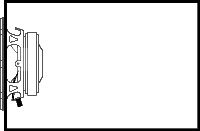
When the volume of air within a sealed enclosure is less than the Vas of the driver, the trapped air acts as an acoustic spring that adds to the restoring force of the speaker. This is called acoustic suspension. Output rolls off at 12dB per octave below F3. A well-designed sealed enclosure exhibits smooth frequency response with excellent cone control at sub-bass frequencies.
Vented Enclosures
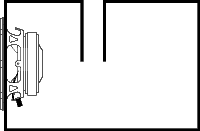
Vented enclosures are also known as ported, bass reflex, tuned, or tuned ported. A vented enclosure is essentially a sealed enclosure with an extra opening that allows the back wave to interact with the front wave. By changing the length or surface area of the opening, you change the tuning frequency of the enclosure.
The advantages of a vented enclosure over sealed: for a given enclosure volume, deeper bass extension or higher output. Near the tuning frequency, almost all output comes from the vent, so cone movement is minimal. The disadvantage: below the tuning frequency, the driver no longer has the restoring force of the enclosure air and behaves as if in free air.
Bandpass Enclosures
Bandpass systems — also referred to as 4th, 5th, 6th, 7th, 8th order enclosures — are best described as single or dual reflex.
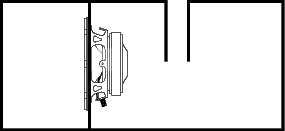
A single reflex system has one side of the speaker in a sealed enclosure and the other in a vented enclosure. Benefits include controlled cone excursion at low frequencies, and the ability to sacrifice efficiency for deeper bass extension or vice versa. The frequency response is controlled by the enclosure volumes and tuning frequencies.
Because all sound from this type of enclosure is produced by the vent, sound quality may not be as good as a properly designed sealed or ported enclosure. However, bandpass enclosures are sometimes the best choice — particularly in sedan applications where multiple rear deck drivers are not practical, or in limited space situations where efficiency can be traded for deeper extension. Efficiency gains of 5–10dB are achievable. As with any enclosure design, there is no free lunch: changing one parameter to gain another often degrades sound quality.
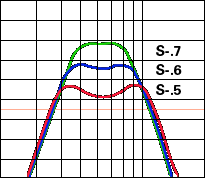
The frequency response in the pass band of a single reflex enclosure is described with an "s factor." S values between .7 and .4 are of primary interest. An s of .7 refers to the flattest available pass band. An s of .4 refers to the widest usable pass band. Values outside this range produce either peaky response or poor sonic quality.
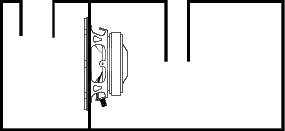
A dual reflex enclosure has a ported cabinet on both sides of the driver. This system uses both the front and back wave, achieving great efficiency. However, like a vented enclosure, below the tuning frequency the driver may move beyond its excursion limits. Since all output is from the ports, distortion cannot be heard until it is too late.
Multiple Drivers
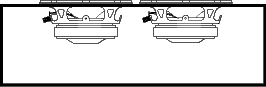
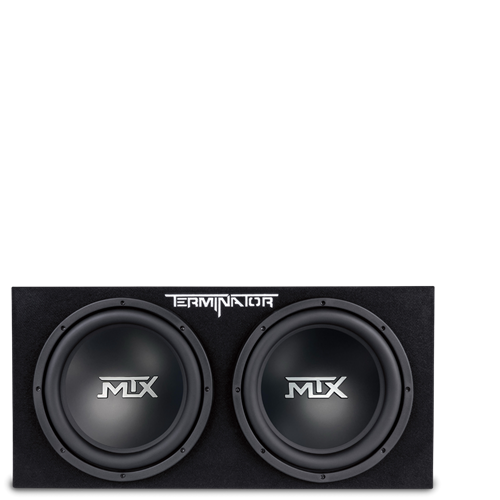
It is often possible to attain better sound quality and higher output for a given airspace by using multiple smaller speakers rather than a single large one. When designing a multi-driver enclosure, double the air space you would use for a single driver. If both speakers receive the same signal, a divider is not necessary. If they operate on different signals, use a divider — otherwise cancellation will result.
Isobaric Systems
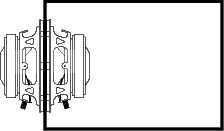
By combining two woofers to act as one — mounted gasket-to-gasket, gasket-to-magnet, or magnet-to-magnet — you create an isobaric system. It requires only half the enclosure volume of a single driver because the effective Vas is halved by having two suspensions on the same diaphragm.
The halving of enclosure size comes at a cost: the isobaric system is 3dB less efficient than a single driver in an enclosure twice the size. To get the same output as one driver, you must double the applied power. However, two isobaric systems — occupying the same space as one single woofer — would have 3dB more output due to increased cone area. By quadrupling both input power and number of drivers, you can achieve 6dB more output in the same space.