Building a quality enclosure is critical to getting the best response out of a subwoofer. Quality construction starts with a quality design. The volume of air contained within the enclosure must be precise. The enclosure must not flex, leak air, or rattle.
Materials
Enclosure walls should be constructed of a high-strength material that will not leak air. The most common choices are Medium Density Fiberboard (MDF) and high-density particle board.
If any wall spans more than 18", brace the enclosure by attaching a 1"×2" piece of wood between opposite walls. Account for the volume this brace displaces.
Attach walls with glue and screws, nails, or staples. Most of the structural strength comes from the glue — use quality wood glue. Pre-drill holes before driving screws or the wood will split. Use cleats (strips of wood glued along the inside edges) for additional strength.
Volume Calculations
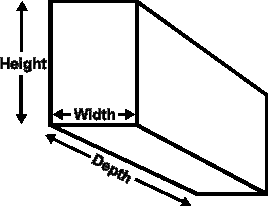
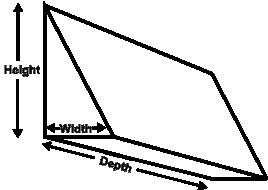
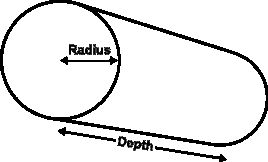
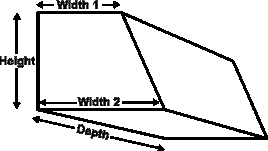
Accurately determining enclosure volume is critical. For complex shapes, break the enclosure into simple component parts, calculate each volume separately, then add them together. Always account for wall thickness. Calculate volume in cubic inches using the formulas below, then divide by 1728 to convert to cubic feet.
Rectangle: H × W × D
Triangle: 0.5 × H × W × D
Cylinder: 3.14 × R × R × D
Wedge: (W1+W2)/2 × H × D
Golden Ratio
Once you have your target volume, the Golden Ratio is a simple method to calculate enclosure dimensions that minimize panel resonances.
Golden Ratio Example — 1.75 ft³ enclosure
1.75 × 1728 = 3,024 in³
∛3,024 = 14.46" (1st dimension)
14.46 ÷ 1.62 = 8.93" (2nd dimension)
14.46 × 1.62 = 23.43" (3rd dimension)
These are internal dimensions. With ¾" wood: external dimensions are 15.96" × 10.43" × 24.93".
Damping
If a sealed enclosure is too large for the available space, it is possible to decrease the necessary box volume by approximately 20% by stuffing the enclosure with 1.5 lbs per cubic foot of a low-density, high specific heat material — fiberglass, Dacron, or long-fiber wool. Keep the stuffing away from the basket and pole piece vent of the speaker, which can be accomplished with a brace placed behind the driver.
Stuffing can also smooth out a bump in the frequency response. By varying the amount of fill you adjust both the bump and the F3 of the system.
Vent Calculation
For a vented enclosure to perform correctly, the port diameter and length must be tuned for the specific enclosure volume and driver. Port diameter minimums:
| Speaker Size | Minimum Port Diameter | Notes |
|---|---|---|
| 8" | 2" | Use larger if possible |
| 10" | 3" | Use larger if possible |
| 12" and larger | 4" | Use larger if possible |
Larger diameter ports are less likely to produce port noise at high volumes. Round over the openings of ports — both inside and outside the enclosure — to reduce turbulence over sharp edges.
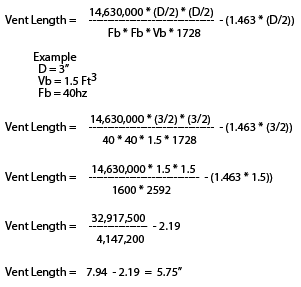
To calculate vent length for a given diameter (D), box volume (Vb in ft³), and tuning frequency (Fb in Hz):
Vent Length Formula
Vent Placement
Think of a vent as a pressure valve. When the input frequency is at or near the tuning frequency, the valve opens to equalize air pressure. Placing the vent opening too close to a wall or the speaker itself changes how this valve operates.
Long Vents
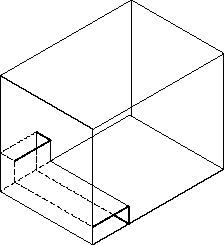
Occasionally a calculated vent length will not fit inside the enclosure without the openings being too close to a wall. Three options exist: use a smaller diameter vent, allow the vent to protrude outside the enclosure, or bend the vent inside the enclosure.
When using PVC pipe, an elbow fitting allows the vent to wrap around the enclosure interior. Measure vent length through the center of the pipe. Rectangular vents offer more flexibility — the enclosure walls themselves can form part of the vent structure. Measure length through the center of the vent opening regardless of shape.
Long Vent Example — integrating a 6" vent into an 18" × 16" × 10" enclosure
Target: a 6" diameter vent 15" long. Convert to a rectangular equivalent (3.76" × 7.52"). Place the vent opening on the same panel as the speaker and use the bottom and side walls of the enclosure to form part of the vent structure.
Diagram — Integrated Vent
Vent Applications
When a subwoofer system is vented, it is critical to allow the sound from the vent to enter the listening area without restriction. Running the vent through the rear deck works but is not the most cosmetically appealing approach.
Placing a grill over a vent changes its tuning and can cause grill material to vibrate at high volumes. To reduce these problems, the grill surface area should be at least three times the surface area of the port — this decrease in airspeed reduces turbulence noise.
The preferred approach is to build a diffuser that couples the airflow from the port directly through the grill, directing all sound into the listening area. When constructing a diffuser:
- The diffuser height should be at least equal to the diameter of the vent
- The diffuser must form an airtight seal between the enclosure and the rear deck
- The diffuser area should be at least three times the area of the vent — larger is better
- For large spans of grill cloth, use hardware cloth or screening below the grill for structural support