If you don't do your research when choosing a car audio amplifier, you could end up with a lot less power than you paid for. Amplifier power ratings — RMS, Max, and Peak — are some of the most misunderstood and most abused specifications in car audio.
Brace yourself: that 3,000-watt amp you found online for $119.99 almost certainly does not have 3,000 watts of output. Here's how to tell.
RMS, Peak, and Max — What They Actually Mean
The Industry Standard: CTA-2006-D
The Consumer Electronics Association created a testing standard — now in its fourth revision as CTA-2006-D — that defines exactly how amplifier power, frequency response, noise, and distortion must be measured and reported. The goal was to eliminate bogus power claims and give consumers a reliable way to compare amplifiers across brands.
The problem is compliance is voluntary. Not all manufacturers follow it, and most consumers would not know which ones do. Manufacturers who do not comply can still publish whatever numbers they want.

All MTX Terminator, Thunder, RTX, Powersports, and Marine amplifier lines are tested and rated to the CTA-2006-D standard. When you see an RMS rating on an MTX amp, it was measured the same way every other compliant amp is measured — under the same conditions, at the same test voltage, with the same distortion limits. That is what makes it a real number.
How to Verify an Amplifier's Real Output
There is a simple way to reality-check any amplifier's power claims using its fuse values. Add up the amperage of all fuses in the amplifier and multiply by 14.4 volts — the standard voltage an automotive electrical system produces when connected to a running alternator.
If the advertised peak or max power is significantly higher than this number, the rating is not achievable. Also check the power and ground terminal size. High-power amplifiers require large-gauge wiring to carry the necessary current — if a supposed 3,000-watt amp has 4 or 8 gauge terminals, the power rating is inflated. Legitimate high-power amplifiers use 1/0 gauge terminals because physics requires it.
A Real Example of Inflated Specs
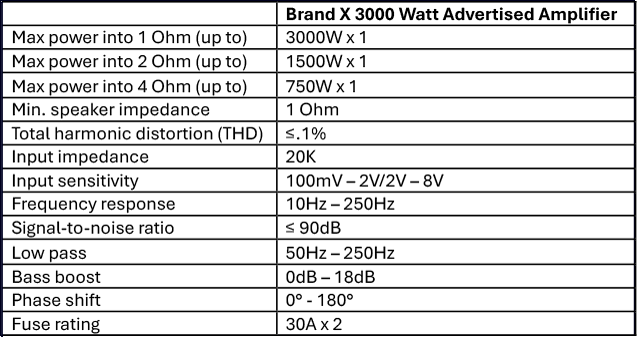
The following specs are taken directly from a real amplifier currently being sold for ~$175 and advertised as a 3,000-watt monoblock. These are not hypothetical numbers. That price is exactly what makes it tempting — and exactly what should make you suspicious.
The published specs show Max Power of 1,500W at 2Ω and 750W at 4Ω. No RMS rating is published at 1Ω — just "Max Power" at 3,000W.
The amplifier has two 30-amp fuses for a total of 60 amps. Using the formula: 60 × 14.4 = 864 watts maximum possible output. The claimed 3,000-watt rating is physically impossible with those fuses — it is more than triple the real number.
Notice also that no RMS rating at the advertised impedance is published anywhere, only "Max Power." That is the tell.
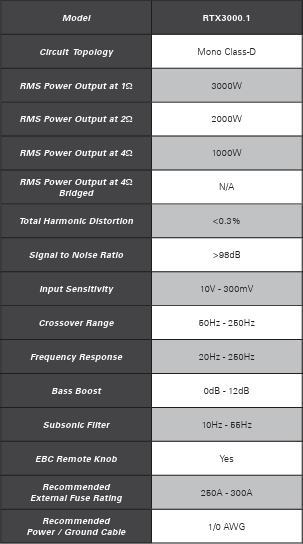
The MTX RTX3000.1 is also advertised as a 3,000-watt monoblock — the same headline number as Brand X. The difference is in the specs. Recommended external fuse rating: 250–300A. Using the conservative end of that range: 250 × 14.4 = 3,600W — comfortably above the rated 3,000W RMS at 1Ω. The math checks out.
Note also: 1/0 AWG recommended power and ground cable — the correct gauge for an amplifier moving this much current. MTX amplifiers are rated for real-world applications. The numbers are honest.
Matching an Amplifier to Subwoofers
When matching an amplifier to subwoofers, use RMS ratings at the final impedance of your wiring configuration. The RMS power the amplifier produces depends on the impedance it is driving — the same amplifier will output different power at 1Ω, 2Ω, and 4Ω.
For example: if your amplifier is rated 1,000W RMS at 1Ω, 600W at 2Ω, and 350W at 4Ω, and your two subwoofers have 500W RMS each, you need 1,000W total. That means wiring to 1Ω to access the full output. Wiring to 4Ω would only give 350W — not enough to power the subs properly.
Step-by-Step Matching Guide
If you already have your subwoofers:
If you already have your amplifier:
Do your research. If you want to test the honesty of someone selling you an amplifier, ask them whether the ratings are realistic. It is always an interesting conversation — even if you already know the answer.