Proper wiring is almost as important to a car audio system's performance as the amplifiers, speakers, and subwoofers themselves. Amplifiers need clean power delivery. Speakers and subwoofers need every watt the amplifier produces. Quality wiring is what makes sure those components actually get what they need to run efficiently and sound their best. Your system is only as good as its weakest link.
Key Wiring Terms
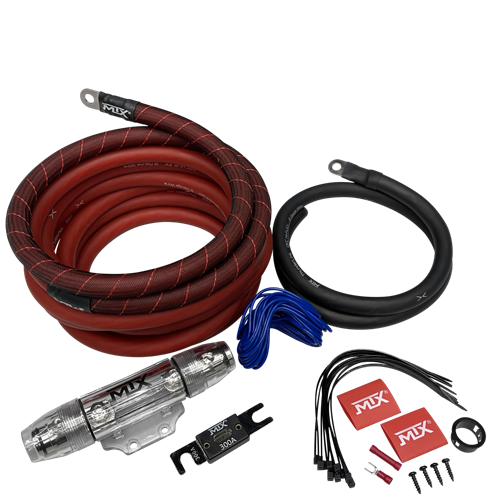
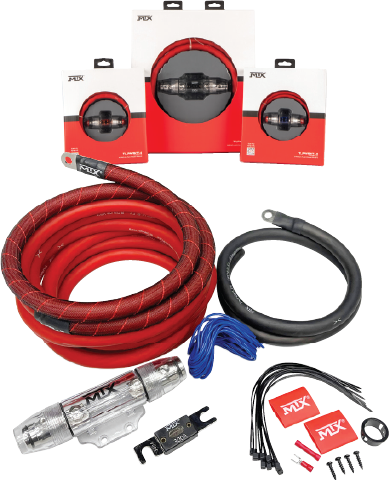
Amplifier wiring kit: Includes power wire, ground wire, remote turn-on wire, fuse, fuse holder, and installation accessories for a clean install without sourcing parts separately. The wire gauge included in the kit must match your amplifier's power rating — using undersized wire causes heat buildup and limits performance.
RCA interconnects: Deliver the audio signal from your head unit to your amplifier. Available in multiple lengths and channel configurations. Factory head units typically do not have RCA outputs, so a line output converter may be needed to convert speaker-level output to an RCA signal.
Power Wire: Gauge and Construction
Amplifiers draw large amounts of current. Wire gauge determines how much current can flow — the lower the AWG number, the thicker the wire and the more current it can carry. Using wire that is too thin for your amplifier causes heat to build up in the cable, reduces efficiency, and can damage the amplifier over time.
| Wire Gauge (AWG) | Amplifier Power Range |
|---|---|
| 1/0 AWG | 1,000W RMS and above |
| 4 AWG | 500 – 1,000W RMS |
| 8 AWG | 250 – 500W RMS |
| 10 AWG | Under 250W RMS |
These are general guidelines. Run length, number of amplifiers sharing a circuit, and ambient temperature can all affect what gauge is appropriate for your specific install.
The most important quality indicator in power wire is the amount of Oxygen Free Copper (OFC) used in construction. OFC has minimal oxygen content, which improves conductivity and reduces signal loss. MTX ThunderLink wiring uses 100% OFC conductors across the full line, providing maximum power transfer. Budget kits often use Copper Clad Aluminum (CCA) or an OFC/CCA blend — CCA has higher resistance and lower conductivity than pure OFC.
ThunderLink power wire uses HI-FLEX insulation, which makes routing through tight spaces significantly easier during installation. Available in black and red.
Speaker Wire
The same principles apply to speaker wire. Your amplifier outputs power to your speakers and subwoofers through speaker wire, and undersized wire cannot carry the full rated output. Connecting a 1,000W RMS subwoofer to a 1,000W amplifier with 18-gauge speaker wire means the sub is not receiving anywhere near its rated power.
ThunderLink speaker wire is available in 12 AWG and 16 AWG with 100% OFC conductors and HI-FLEX insulation. A round side and square side on the cable designate positive and negative, making polarity easy to identify during installation without needing to read labeling in tight spaces.
RCA Interconnects
The audio signal running from your head unit to your amplifier is a small current. A poor connection distorts or loses the signal entirely. Connector oxidation — caused by low-quality metal plating — develops over time and degrades signal quality. Twisted pair cable construction rejects radio frequency interference, which is particularly important in automotive environments with alternators, ignition systems, and other electrical noise sources.
- Double twisted pair for maximum noise rejection
- Slotted connector and split center pin for a secure connection
- Braided nylon sleeve for protection and clean appearance
- Extended split cable design for multi-amp setups
- Cables numbered on both ends for 4 and 6 channel runs
- 100% OFC conductors for pure signal transfer
- HI-FLEX cable insulation for durability and flexibility
- Twisted pair design for noise rejection and reduced interference
For most single-amplifier setups, the 1-Series is the right choice. For more complex installs with multiple amplifiers or 4 and 6-channel configurations, the 3-Series adds the numbered cables and extended split design that makes a multi-amp wiring run significantly easier to manage.